
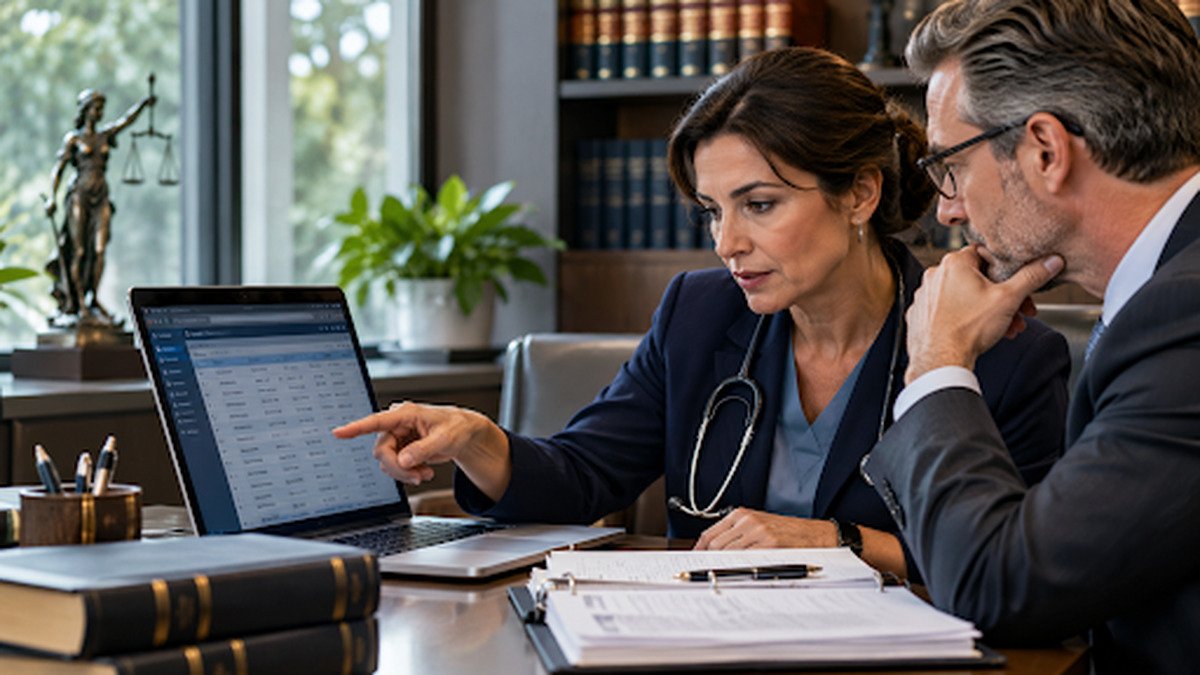
An independent medical examination (IME) can become an important event in personal injury, workers' compensation, and other medical-legal disputes. The examining healthcare professional may evaluate an individual's medical condition, functional limitations, treatment history, or claimed injuries.
Because examination findings can influence litigation strategy and expert opinions, attorneys need a clear understanding of what actually occurred during the appointment.
A nurse observer for an independent medical examination provides clinical observation and documentation that may help an attorney evaluate the examination process and its resulting report.
Unlike an attorney or a nonclinical observer, a qualified nurse brings healthcare knowledge to the observation, including familiarity with physical examination techniques, medical terminology, patient responses, and clinical documentation.
However, the observer's responsibilities must remain consistent with applicable laws, examination rules, consent requirements, and the agreed scope of the assignment.
Understanding this role can help attorneys decide when professional nursing observation may add value to a medical-legal case.
What Is an Independent Medical Examination?
An independent medical examination is a medical assessment typically conducted by a healthcare professional who is not serving as the examinee's regular treating provider.
Depending on the case, an IME may be requested by an insurer, employer, attorney, or another party authorized under applicable procedures.
The examination may address questions about:
The nature and extent of a reported injury.
Current symptoms and functional limitations.
The relationship between an incident and a medical condition.
Treatment history and medical findings.
Impairment or disability-related issues.
Future treatment considerations.
An IME is different from a routine appointment with a treating physician.
According to the American Medical Association's guidance on work-related and independent medical examinations, the examining physician generally establishes a limited patient-physician relationship for the evaluation rather than an ongoing treatment relationship.
This distinction matters because the examiner's primary assignment is usually to provide an objective medical assessment rather than continuing clinical care.
What Is a Nurse Observer During an IME?
A nurse observer is a qualified nursing professional who attends an independent medical examination, when permitted, to observe and document relevant aspects of the encounter.
The observer may be retained to assist an attorney in understanding how the examination was conducted and whether the resulting documentation accurately reflects observable events.
A nurse observer does not replace the examining physician, independently diagnose the examinee, or direct the medical assessment.
Instead, the nurse may document matters such as:
The examination's start and end times.
The individuals present during the appointment.
Examination techniques that were visibly performed.
Instructions provided to the examinee.
Relevant patient responses.
Observable physical limitations.
Events that interrupted or affected the examination.
A properly prepared observation report should separate directly observed facts from clinical interpretation.
For attorneys, that distinction can be important when comparing the observer's notes with the examiner's eventual written findings.
Why Attorneys May Benefit From an IME Nurse Observer
1. Obtaining an Independent Account of the Examination
An IME report usually reflects the examining professional's evaluation, observations, and conclusions.
When examination procedures are later questioned, an additional documented account may help clarify what occurred.
A nurse observer can record relevant events in a structured manner, including examination sequence, instructions, and observable responses.
For example, if a medical report describes a range-of-motion assessment, the observer's notes may help the attorney understand which movements were actually performed.
This does not automatically mean that a disagreement between accounts establishes an error.
Differences should be assessed carefully against the examination report, applicable clinical methods, and other available evidence.
2. Documenting Examination Procedures
Medical assessments frequently involve specialized techniques that may be difficult for individuals without clinical training to recognize.
A nurse observer may identify whether particular tests, movements, or assessment procedures were conducted during the encounter.
Clinical familiarity can be valuable when documenting:
Musculoskeletal examination activities.
Neurological screening procedures.
Observable gait or mobility assessments.
Strength and movement testing.
Patient positioning.
Examination instructions and responses.
The observer should avoid making unsupported conclusions about why an examiner did or did not perform a particular technique.
Different medical specialties and referral questions may require different examination approaches.
The appropriate analysis depends on the case and the purpose of the evaluation.
3. Recording Patient Responses and Limitations
Examinees may describe pain, discomfort, weakness, dizziness, or other symptoms during an assessment.
An observer can document those reported experiences and relevant visible responses.
For example, an examinee may indicate increased discomfort during a specific movement or request a pause before continuing.
The nurse can document what was said and what was observed without independently determining whether the symptom establishes a particular medical diagnosis.
This record can provide useful context if the final examination report summarizes the encounter differently.
It is important to distinguish a patient's self-reported symptom from an objective clinical finding.
Both may be relevant, but they are not interchangeable.
The Importance of Objective Observation
A nurse observer's credibility depends on accurate and impartial documentation.
The observer should not approach the examination with the assumption that the examiner will act improperly or that the examinee's reported limitations must be accepted without evaluation.
Instead, the goal is to provide a reliable account of the encounter.
Recording Facts Without Advocacy
An observation report should use neutral descriptions whenever possible.
For instance, documenting that the examinee stopped a movement after reporting pain is more precise than asserting that the examiner caused an injury without supporting evidence.
Similarly, the observer should not characterize an examination as incomplete merely because a particular test was not performed.
That conclusion may require review of the referral questions, clinical standards, examination specialty, and relevant medical history.
Respecting the Examination Process
An observer should avoid interfering with the examiner's professional responsibilities.
The observer's presence, permissible activities, and ability to take notes or record the encounter may depend on jurisdiction-specific rules, court orders, consent, and examination arrangements.
Attorneys should verify those requirements before arranging an observation.
A nurse observer's role is to document permitted activities, not to control the examination.
How Nurse Observers Help Attorneys Evaluate IME Reports
After the appointment, an examiner may issue a report addressing medical findings and opinions relevant to the dispute.
An attorney may want to compare that report with the available records and the events documented during the examination.
A nurse observer's report can support this review by identifying:
Examination activities documented during the appointment.
Relevant statements made during the encounter.
Observable patient responses.
Timing and sequence of procedures.
Potential differences between observed events and the final report.
These observations can help attorneys formulate questions for further review.
However, an observer's account should not be treated as proof that an examiner's medical conclusions are incorrect.
Determining the reliability of those conclusions may require evaluation by an appropriately qualified medical expert.
The International Academy of Independent Medical Evaluators emphasizes the importance of well-supported medical reasoning and objective reporting in independent medical evaluations.
Preparing a Client for an Independent Medical Examination
Appropriate preparation can help reduce confusion and ensure that attorneys understand the examination requirements.
Preparation should emphasize accurate communication and compliance with applicable rules rather than coaching an examinee to produce particular findings.
Review Relevant Medical Records
Before an examination, attorneys may benefit from organizing the client's relevant treatment history.
A structured review can identify important diagnoses, prior injuries, treatment dates, and recent clinical findings.
Legal Nurse Expert's Medical Summaries, Timelines & Chronologies services can help organize these records for case preparation.
The resulting documents may also help attorneys recognize which medical facts require additional clarification.
Clarify Examination Logistics
Attorneys should confirm the examination date, location, examiner, applicable instructions, and permitted attendance arrangements.
They should also verify any rules concerning recording devices, note-taking, observers, or support persons.
These requirements can differ substantially depending on the jurisdiction and type of claim.
Encourage Accurate Communication
Examinees should be encouraged to provide truthful information about their symptoms, limitations, and medical history.
They should not exaggerate, minimize, or conceal relevant information.
Accurate communication supports a more reliable clinical evaluation and helps reduce unnecessary inconsistencies.
What Happens After the IME?
When the examination concludes, the nurse observer may prepare a written report within the authorized scope of the assignment.
A clear report may contain the encounter date, location, participants, examination sequence, observed procedures, relevant statements, and notable events.
The attorney can then review that report alongside the examiner's findings and other case documentation.
If differences arise, the legal team can determine whether further investigation, record review, or expert consultation is appropriate.
Attorneys may also use observations to prepare focused questions for depositions or additional case analysis.
An observer report is one component of the evidentiary record, not a replacement for medical expert testimony.
Choosing the Right Nurse Observer for an IME
Selecting an observer should involve more than confirming a nursing license.
Relevant considerations include professional experience, clinical knowledge, documentation skills, understanding of medical-legal assignments, and the ability to remain impartial.
An attorney may wish to ask whether the nurse has experience with the type of examination involved and can produce a detailed, objective report.
Experience with medical records, rehabilitation, patient assessment, or related clinical specialties may be particularly relevant depending on the case.
Legal Nurse Expert provides DME/IME Client Representation, including clinical observation and reporting support for attorneys.
Its services also include medical record review and litigation-related case analysis for plaintiff and defense counsel nationwide.
When Should an Attorney Consider a Nurse Observer?
A nurse observer may be worth considering when the examination involves complex medical conditions, disputed functional limitations, or procedures that could benefit from clinically informed documentation.
Potential situations include:
Significant musculoskeletal injuries.
Neurological or rehabilitation-related assessments.
Disputed descriptions of physical limitations.
Evaluations involving extensive medical histories.
Cases where examination procedures may become a point of disagreement.
The decision should be based on the actual needs of the case, governing requirements, and whether observation is legally and practically permitted.
Not every IME requires a nurse observer.
The important question is whether independent clinical documentation would provide meaningful assistance in evaluating the examination.
Frequently Asked Questions
What does a nurse observer do during an independent medical examination?
A nurse observer documents permitted examination activities, relevant statements, patient responses, and observable procedures. The nurse does not replace the examiner or provide an independent diagnosis during the observation.
Can a nurse observer attend every IME?
No. Attendance depends on applicable laws, procedural rules, consent requirements, court orders, and examination arrangements. Attorneys should confirm authorization before scheduling an observer.
Can an IME nurse observer challenge the examiner's conclusions?
A nurse observer may document discrepancies or issues requiring clarification, but the observation alone does not establish that a medical opinion is incorrect. Qualified expert review may be necessary.
Is a nurse observer the same as a medical expert witness?
Not necessarily. Observation and expert testimony are different assignments. Whether a nurse qualifies to provide expert opinions depends on relevant qualifications, the subject matter, and applicable evidentiary standards.
Get Professional DME/IME Observation Support
Independent medical examinations can introduce important clinical information into a legal case.
For attorneys, understanding the examination process and maintaining accurate documentation can support informed decisions during litigation.
A qualified nurse observer may provide valuable assistance by documenting permitted examination activities, identifying relevant clinical details, and helping legal teams understand the encounter.
Legal Nurse Expert offers DME/IME client representation and related medical-legal consulting services for attorneys handling personal injury and medical malpractice matters.
Preparing for an upcoming independent medical examination?
Contact Legal Nurse Expert to discuss your case and determine whether clinical observation support is appropriate.